 Threat Intelligence
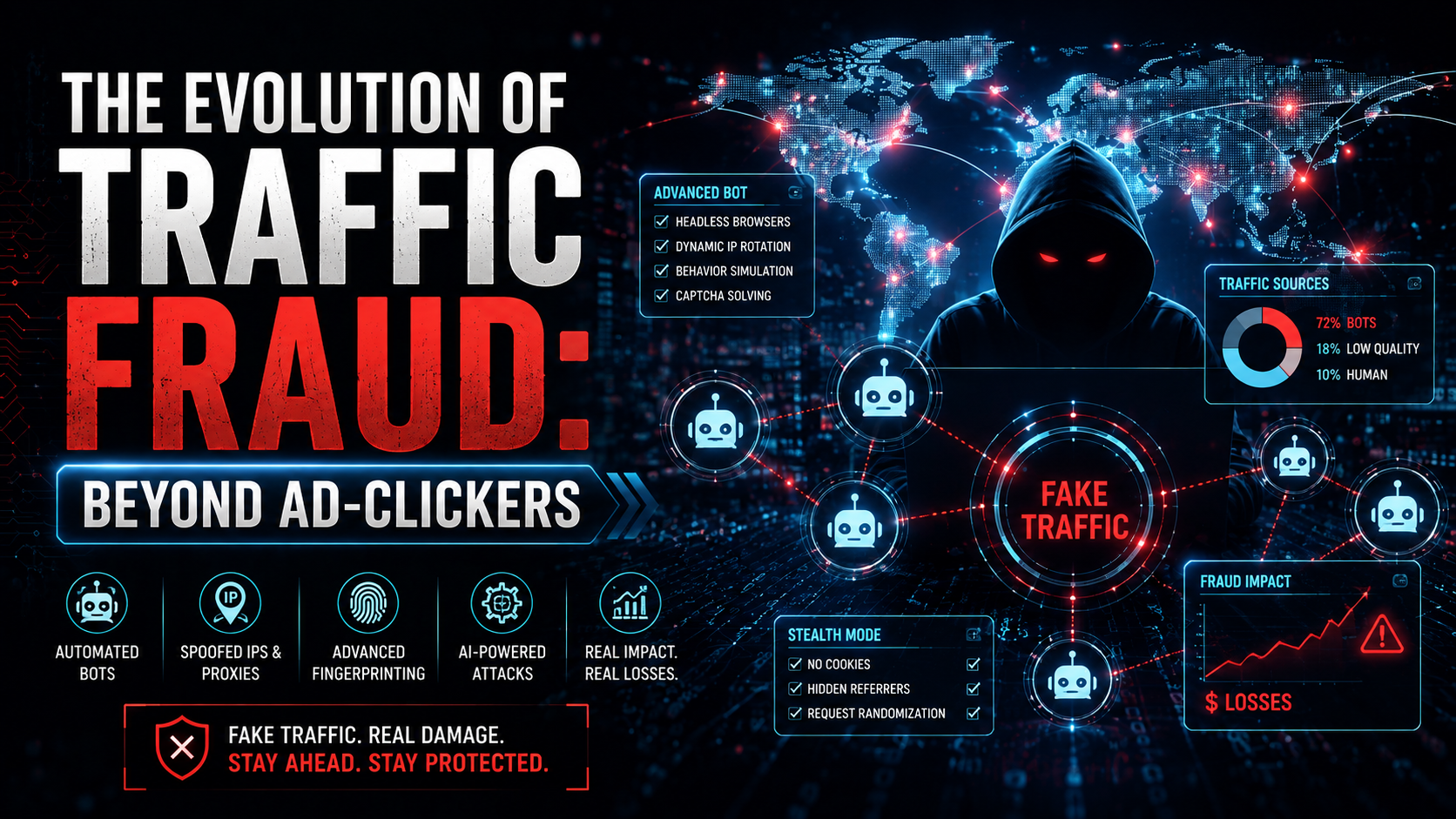
The Evolution of Traffic Fraud: Beyond Ad-Clickers
Traffic fraud has evolved from simple ad-clicking scripts into complex ecosystem simulations designed to blend automated activity with legitimate user behavior. Modern fraud networks can use distributed infrastructure, rotating identities, automated browsers, and residential proxy networks that route requests through legitimate consumer IP addresses. As a result, IP-based blacklisting alone is no longer a reliable method for separating fraudulent traffic from genuine visitors.
Residential botnets present a particularly difficult challenge because the underlying network addresses may have little or no obvious history of abuse. A request arriving from a residential connection can therefore look considerably more trustworthy than one originating from a known data-center range. However, the network location is only one signal. When behavioral telemetry, request patterns, device characteristics, and historical activity are analyzed together, additional evidence can emerge.
The Rise of Stealth-Browsing Sessions
Another important development is the emergence of so-called “stealth-browsing” activity. These sessions are not necessarily designed to generate immediate advertising clicks or obvious fraudulent conversions. Instead, automated visitors may browse websites, perform searches, view content, and interact with pages in an attempt to establish a history that resembles ordinary user activity.
Our recent audit of a global retail network revealed a 40% increase in sessions exhibiting characteristics associated with this type of activity. The most concerning aspect was that many of these sessions did not initially trigger conventional fraud rules. They generated ordinary page views and searches, maintained relatively normal session durations, and avoided the aggressive request patterns typically associated with simple bots.
This illustrates an important limitation of short-term traffic analysis. A session that appears harmless when examined in isolation may become considerably more suspicious when its activity is evaluated alongside its historical behavior.
Why “Trust Building” Creates a Detection Challenge
Fraud detection systems frequently rely on recent activity. A visitor arrives, performs several actions, and is assigned a risk score based on the information available at that moment. This approach works well for obvious attacks, but it becomes more complicated when suspicious activity develops gradually.
An automated browsing profile may initially generate low-risk activity and only later attempt a high-value action. The earlier sessions can create a misleading appearance of legitimacy if the detection system evaluates each visit independently.
This is why behavioral history can be more informative than a single session. The question is not simply whether a visitor behaved normally today. The more useful question may be whether the visitor's activity over time is consistent with the behavior expected from a genuine customer.
Longitudinal Traffic Analysis
Defending against these “sleeper agents” requires longitudinal analysis. Instead of looking exclusively at individual sessions, forensic systems can evaluate behavioral patterns across longer periods and identify relationships between seemingly unrelated events.
A longitudinal model can examine changes in browsing frequency, navigation behavior, interaction patterns, device characteristics, referral sources, and transaction activity. The objective is to identify patterns that would be difficult to recognize when every visit is treated as an isolated event.
For example, a sequence of ordinary searches may not be suspicious by itself. However, if the same behavioral profile repeatedly appears before account activity, promotional abuse, fraudulent purchases, or unusual conversion events, the historical relationship becomes an important analytical signal.
From Session Detection to Profile Detection
This represents a fundamental change in traffic forensics. Traditional systems often ask, “Is this request suspicious?” More advanced systems increasingly ask, “Does the behavior associated with this profile remain consistent over time?”
That distinction matters because sophisticated automation can change individual characteristics between sessions. IP addresses may change, browser attributes may vary, and request timing may be deliberately modified. A detection architecture that evaluates only one session at a time can therefore lose valuable context.
Profile-level analysis can instead look for persistent relationships among events while avoiding dependence on a single identifying attribute. This can help security teams recognize recurring behavioral patterns even when individual technical signals change.
Cross-Domain Activity and Correlation
In large digital ecosystems, fraudulent activity may also extend across multiple properties. A visitor might interact with an advertising landing page, visit an ecommerce website, access a promotional system, and eventually reach a transaction or account-management endpoint.
Correlating activity across domains can provide additional context, but this must be implemented carefully. Organizations should only correlate data when they have an appropriate legal and technical basis for doing so, and privacy controls should be incorporated into the architecture from the beginning.
When properly designed, cross-domain analysis can help identify broader traffic patterns that would remain invisible when each website operates its fraud detection system independently.
Detecting Patterns Instead of Single Indicators
The key lesson is that sophisticated traffic fraud rarely depends on one detectable characteristic. An individual IP address, browser fingerprint, user agent, or session duration may look completely normal.
The stronger signal often comes from the relationship between multiple observations.
A session with a residential IP address, for example, should not automatically be considered legitimate. Likewise, a browser that successfully executes JavaScript should not automatically be considered human. These attributes provide context, but they become significantly more useful when combined with behavioral history and transaction outcomes.
Modern detection systems can therefore assign risk based on multiple independent or partially independent signals. The resulting score can be continuously updated as new evidence becomes available.
Reducing False Positives
Longitudinal analysis also creates an opportunity to reduce false positives. Blocking users solely because they share a network, use privacy tools, or exhibit unusual browsing behavior can inadvertently affect legitimate customers.
A more cautious system can use historical evidence to determine whether an anomaly represents a genuine risk. Instead of immediately blocking an uncertain visitor, the platform can increase monitoring, apply rate limits, request additional verification, or flag the session for further analysis.
This risk-based approach is especially important for ecommerce platforms, financial services, advertising systems, and other environments where incorrectly blocking legitimate users can have a direct commercial impact.
The Future of Traffic Forensics
The evolution of traffic fraud demonstrates why modern detection cannot rely exclusively on static blacklists or simple bot signatures. Fraud networks can distribute activity, imitate legitimate browsing, vary technical characteristics, and remain inactive until an opportunity appears.
Organizations therefore need to move toward continuous behavioral analysis. By combining real-time signals with historical context, businesses can develop a more complete picture of how traffic behaves before, during, and after important events.
The objective is not to assume that every unusual visitor is fraudulent. Instead, the goal is to identify statistically meaningful patterns, assign appropriate levels of risk, and give security teams enough context to make informed decisions.
As automated traffic becomes increasingly capable of imitating legitimate users, the ability to understand the complete lifecycle of a browsing profile may become just as important as detecting the individual request itself.