 System Defense
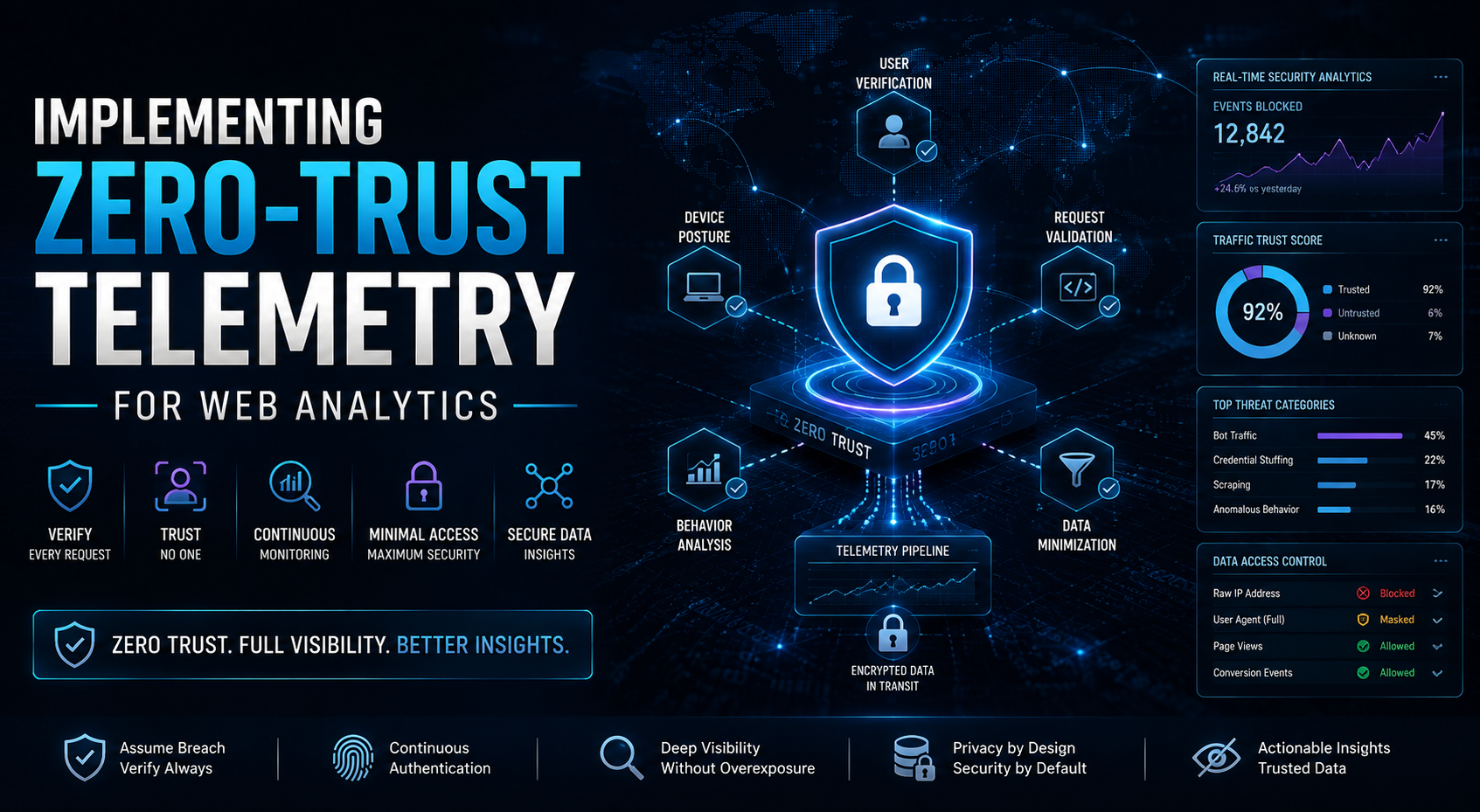
Implementing Zero-Trust Telemetry for Web Analytics
Zero-Trust is not limited to network access and identity management. The same principle can be applied to modern web analytics, where every incoming session is treated as untrusted until sufficient evidence demonstrates that it is consistent with legitimate activity. This approach is becoming increasingly relevant as automated traffic becomes more capable of imitating genuine visitors.
Traditional analytics systems often assume that a browser session represents a real person unless a known bot signature is detected. That assumption becomes increasingly unreliable when automation can rotate network addresses, execute JavaScript, maintain cookies, simulate interactions, and distribute activity across large infrastructure networks.
A Zero-Trust analytics model reverses that assumption. Instead of asking whether a visitor can be proven to be malicious, the system continuously evaluates whether the available evidence is sufficient to establish an appropriate level of trust.
What Zero-Trust Means for Web Analytics
In a conventional analytics environment, a page view may immediately become part of a website's traffic statistics. A Zero-Trust approach introduces an additional layer of evaluation before that activity is considered reliable enough for sensitive analytics or business decisions.
This does not mean that every visitor should be challenged or blocked. The objective is to classify traffic according to confidence and risk.
A normal visitor who behaves consistently with established legitimate traffic can receive a high trust score. An unusual session may remain in an uncertain category while additional evidence is collected. A session exhibiting multiple high-risk indicators can receive a low score and trigger additional controls.
This creates a more flexible model than a simple “bot or human” classification.
A Layered Telemetry Architecture
A Zero-Trust telemetry stack can combine multiple independent sources of evidence. Each layer provides a different perspective on the session, reducing reliance on any single signal.
- Network intelligence: Evaluates network reputation, request patterns, and infrastructure characteristics.
- Browser signals: Examines supported browser capabilities and consistency between reported and observed characteristics.
- Behavioral telemetry: Measures navigation, interaction timing, scrolling, clicks, and other legitimate user-interface events.
- Session analysis: Evaluates the relationship between events throughout the lifetime of a session.
- Historical analysis: Compares current activity with previously observed patterns.
- Application controls: Applies additional verification when a visitor attempts a sensitive action.
The strength of this architecture comes from combining signals rather than treating any single characteristic as conclusive evidence.
Browser Environment Verification
Browser environment verification can provide useful security telemetry, but it should be treated as one component of a larger detection system. Modern browsers expose many capabilities that can help applications determine whether a session behaves consistently with its declared environment.
In higher-assurance environments, organizations may also use cryptographic mechanisms to establish greater confidence in the integrity of a device or application environment where the platform supports them. These mechanisms can provide stronger evidence than ordinary browser attributes because cryptographic verification can establish that certain information originated from a trusted component.
However, not every website needs this level of verification. For ordinary publishing and ecommerce environments, behavioral and server-side signals may provide sufficient protection without introducing unnecessary technical complexity.
Server-Side Challenge and Response
Another component of a Zero-Trust model is server-side challenge-response verification. Instead of relying exclusively on what the browser reports, the server can evaluate whether requests satisfy expected application rules and security conditions.
Additional verification can be introduced when a session reaches a sensitive operation. Examples include account creation, password recovery, checkout, promotional redemption, or other actions where automated abuse could have a significant impact.
Modern verification does not always need to involve a traditional visual CAPTCHA. Depending on the risk level, an application may use background verification, rate controls, authentication requirements, or other mechanisms designed to distinguish legitimate activity from suspicious automation while minimizing unnecessary friction.
Continuous Behavioral Monitoring
Trust should not necessarily be permanent.
A visitor may begin with behavior that appears completely normal and later exhibit patterns that significantly change the risk assessment. For this reason, a Zero-Trust analytics system can continuously reevaluate the session as new telemetry becomes available.
For example, the initial page view may provide very little information. Additional navigation events can establish a behavioral pattern. A sudden change in request frequency or an unusual attempt to access a sensitive function can then increase the risk score.
Continuous monitoring allows the system to respond to changes rather than making a single decision at the beginning of the session.
Moving Beyond “Bot or Human”
Binary classification is often too simplistic for modern traffic analysis. Real-world traffic exists on a spectrum.
A search-engine crawler is automated but legitimate. A monitoring service may generate automated requests for operational purposes. A privacy-conscious human may exhibit characteristics that look unusual to a simplistic detection system. Meanwhile, sophisticated fraudulent automation may closely resemble legitimate browsing.
A multi-dimensional trust model provides more flexibility.
Instead of assigning only two possible classifications, the system can maintain several risk dimensions. These might include automation likelihood, network risk, behavioral consistency, session integrity, and transaction risk.
The resulting profile can then be converted into an overall confidence or trust score.
How a Trust Score Can Influence Responses
The primary advantage of a trust score is that it allows security controls to respond proportionally.
A high-trust session may receive the normal website experience without additional intervention. A medium-trust session might receive increased monitoring or stricter rate controls. A low-trust session could require additional verification before performing a sensitive action.
This approach avoids treating every suspicious signal as an automatic reason to block the visitor.
For example, a visitor who has an unusual network configuration but otherwise behaves like a genuine customer may not need to be blocked. The system can instead continue monitoring the session and increase verification only if additional risk indicators appear.
Protecting High-Value Actions
Not every website interaction has the same security importance.
Viewing a public article generally presents a lower risk than changing account credentials, submitting a payment, claiming a limited promotion, or creating hundreds of accounts. A Zero-Trust model can therefore apply different trust requirements depending on the sensitivity of the requested operation.
This concept is sometimes described as risk-based authentication or adaptive security. The level of verification increases when the potential impact of abuse increases.
Such an approach can improve both security and usability because legitimate visitors are not subjected to the strongest controls for every low-risk page view.
Low-Trust Sessions and Content Delivery
Low-trust traffic does not always need to be immediately rejected. Depending on the application, organizations may choose to limit functionality, apply stricter rate controls, delay sensitive operations, or serve a reduced version of certain resources.
Any such response should be carefully designed to avoid creating unintended discrimination against legitimate users. The purpose is to protect resources and sensitive operations while preserving normal access whenever confidence remains sufficient.
For analytics, suspicious sessions can also be separated from trusted traffic rather than simply deleted. This allows analysts to investigate unusual activity without allowing potentially fraudulent sessions to distort important business metrics.
Data Integrity Is the Central Objective
The purpose of Zero-Trust analytics is not simply to block bots. One of its most important objectives is maintaining the integrity of the data used to make business decisions.
If automated traffic generates millions of artificial page views, advertising impressions, searches, or engagement events, standard analytics can produce misleading conclusions. Marketing teams may incorrectly identify successful campaigns, publishers may misinterpret audience growth, and security teams may overlook abnormal activity hidden inside large volumes of apparently normal traffic.
Separating traffic according to confidence allows organizations to create more reliable reporting pipelines.
Privacy Must Remain Part of the Design
Behavioral telemetry and trust scoring also create privacy responsibilities. A security system should collect only the information necessary for its stated purpose and should establish appropriate retention, access, and security controls.
Organizations should avoid treating behavioral analysis as an excuse to collect unlimited information about visitors. Data minimization, transparency, access controls, and applicable privacy requirements should remain part of the architecture from the beginning.
A strong security model protects both the website and the people who legitimately use it.
Why Zero-Trust Analytics Is Becoming More Important
As automated systems become better at imitating ordinary browsers, the distinction between legitimate and fraudulent traffic becomes increasingly difficult to establish through static rules alone.
Zero-Trust analytics provides a framework for dealing with this uncertainty. Rather than assuming that traffic is trustworthy because it passes one test, the system continuously evaluates evidence and adjusts its confidence as new information becomes available.
This creates a more resilient architecture for environments where traffic quality directly affects revenue, analytics, security, or customer accounts.
The long-term goal is not to create a system that blindly rejects anything unusual. It is to build a system that understands context, measures risk, protects high-value operations, and maintains reliable analytics without unnecessarily interfering with legitimate visitors.
Conclusion
Zero-Trust principles provide a useful foundation for the next generation of web analytics and traffic security. By treating every session as potentially untrusted and continuously evaluating its behavior, organizations can reduce their dependence on outdated binary bot detection.
A layered telemetry stack can combine network intelligence, browser signals, behavioral analysis, server-side verification, historical context, and adaptive risk scoring. Together, these signals provide a more complete picture of traffic quality than any individual fingerprint or blacklist can provide.
The result is a shift from simple bot detection toward continuous trust evaluation. Instead of asking whether a visitor is definitively human, organizations can ask a more useful question: how much confidence should the system place in this session, and what level of access or verification is appropriate for the risk involved?
That change in perspective can help businesses protect sensitive operations, reduce fraudulent activity, and preserve the integrity of the analytics data that increasingly drives digital decision-making.